Howdy!

Air Ambulance Website Design for Trust, Medical Capabilities, and Urgent Inquiries

Sergiy Kravchuk

Sergiy Kravchuk

Sep 13, 2026
Share this article
Air Ambulance Website Design for Trust, Medical Capabilities, and Urgent Inquiries
Medical aviation websites

Air Ambulance Website Design for High-Stakes Decisions

Air ambulance website design has to do more than present a company professionally. It must help families, hospitals, case managers, assistance organizations, and other decision-makers quickly understand medical capabilities, transport options, service areas, and how to start an urgent inquiry. A strong website combines trust-focused content, clear navigation, conversion-focused UX, technical SEO, and fast access to human contact without overwhelming visitors who may already be under pressure.
Trust Make credentials, experience, medical capabilities, aircraft information, and operational details easy to verify.
Capability Explain what the medical team, aircraft, equipment, coordination process, and transfer services can support.
Urgency Reduce friction between arrival on the website and the first qualified inquiry, especially on mobile devices.
Clarity Organize complex aviation and medical information so both families and professional coordinators can understand the next step.
Air Ambulance Website Design for High-Stakes Decisions
Quick answer

What Makes an Air Ambulance Website Effective?

An effective air ambulance website is a conversion and information system for time-sensitive medical transport decisions. It should immediately explain who the service is for, what types of transport and medical support are available, where the operator works, how the coordination process begins, and how to contact the team. The strongest sites balance medical aviation website design, technical credibility, search visibility, and urgent inquiry UX without making claims that cannot be verified.
01

Establish trust quickly

Visitors should be able to identify the operator, understand its services, review relevant credentials or operational information, and see clear contact details without searching through several pages. Trust signals work best when they are specific, factual, and placed near the decisions they support.
02

Explain medical capabilities

Describe transport types, medical staffing, equipment categories, aircraft capabilities, ground coordination, and transfer support in plain language. Separate confirmed capabilities from situations that require case review so visitors understand what can be discussed without assuming every patient is automatically suitable for transport.
03

Support urgent inquiries

Urgent users need visible phone or messaging options, a short inquiry path, and clear instructions about the information the coordination team needs. The site should never create unnecessary form friction between a serious request and a qualified human response.
04

Be understandable to search and AI systems

Clear service pages, descriptive headings, useful FAQs, internal links, structured information, and technically accessible content help Google and AI systems understand what the company does. This supports organic SEO, AI Visibility, and better matching between specific transport needs and relevant website pages.
Website strategy

Air Ambulance Website Design Must Support Fast, Informed Decisions

A general corporate website can assume that visitors have time to browse. An air medical transport website often cannot. A family member may be trying to arrange a transfer, a hospital may need to understand transport capability, or an assistance coordinator may be comparing operators across locations. The website therefore needs a clear information hierarchy that moves from immediate understanding to capability verification and then to contact, while still supporting detailed research for professional users.
Custom Website Development
For immediate medical emergencies, website content should clearly direct users according to the operator's approved emergency communication procedures rather than creating confusion between emergency services and transport coordination.
Air Ambulance Website Design Must Support Fast, Informed Decisions

Design for multiple decision-makers

Families, physicians, discharge planners, case managers, insurers, assistance companies, and corporate travel teams may arrive with different questions. The information architecture should give each audience a fast route to the details that matter without creating separate, disconnected websites.

Explain capabilities before asking for commitment

Visitors may need to understand whether the service handles domestic transfers, international repatriation, critical care transport, commercial medical escorts, neonatal or pediatric cases, or other specialized situations. Only capabilities the operator can substantiate should be presented, and complex cases should be framed as requiring clinical or operational review.

Connect aviation and medical information

A medevac website design should not treat the aircraft and medical team as unrelated topics. Explain how cabin configuration, medical equipment, clinical staffing, range, airport access, and ground coordination affect the overall transport solution.

Make geography understandable

Clarify whether the organization serves specific regions, national routes, international destinations, or worldwide coordination through an operational network. Location pages and service-area content should describe real capability instead of implying offices, bases, or local presence that do not exist.

Create a deliberate urgent inquiry path

Place contact options near high-intent information and explain what details are useful for an initial review, such as origin, destination, patient condition, requested timing, and contact information. Keep the first step concise enough for mobile users while allowing staff to gather additional details after contact.

Build search visibility into the architecture

Service pages, aircraft information, route or region content, FAQs, and educational resources can support organic SEO when each page has a clear purpose. Technical SEO, internal linking, crawlability, page performance, metadata, and structured content should be part of development rather than added only after launch.
Selected work Selected work

Selected Web Fly Projects

Featured case

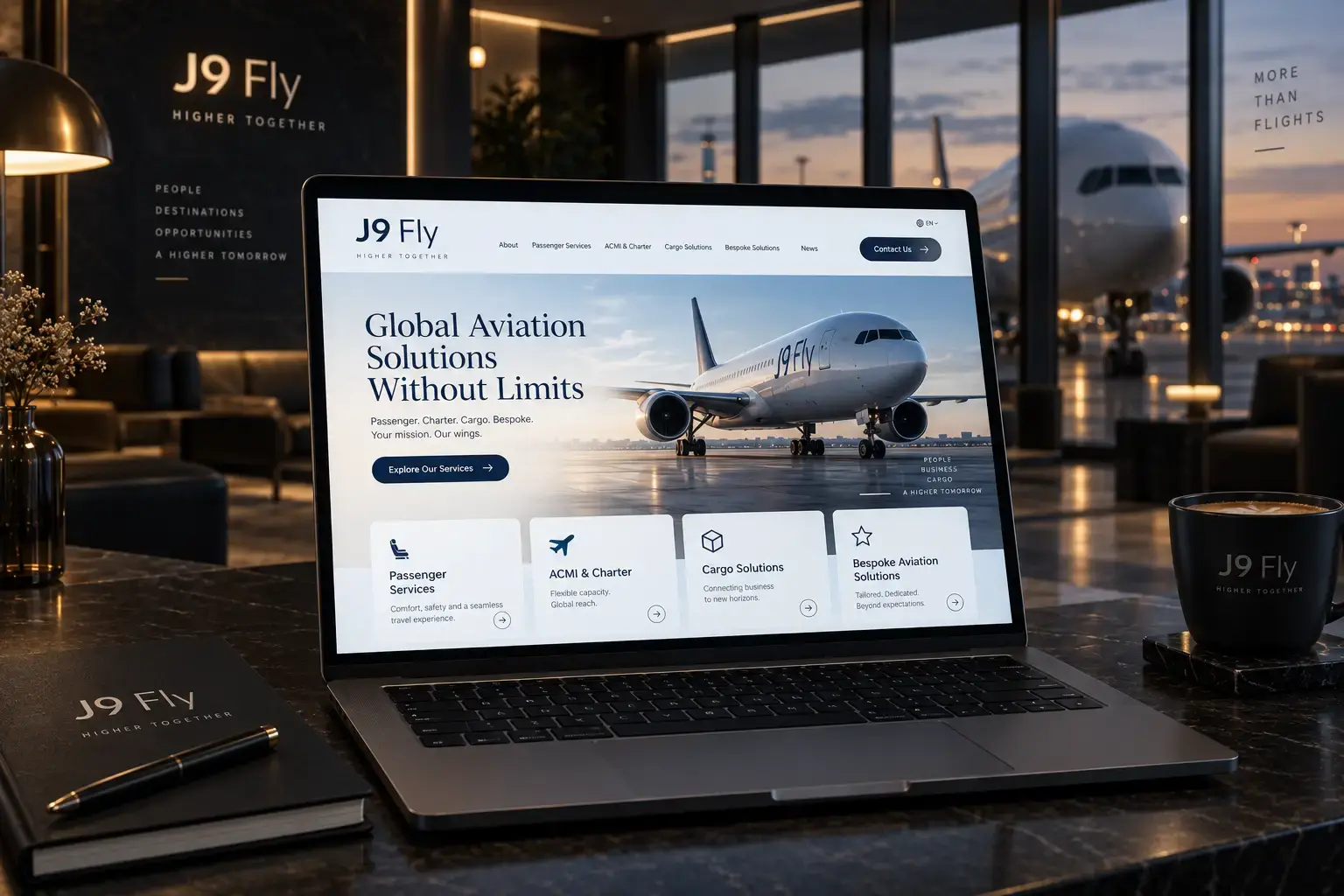
Aviation Website Design & Development for J9 Fly

Custom aviation website design and aviation website development for J9 Fly, built with Laravel Botble, bilingual content, responsive layouts, and editable CMS sections.

Core requirements

Six Priorities for Air Ambulance Website Design

The best air medical websites reduce uncertainty instead of adding more marketing noise. These six priorities help turn a complicated medical aviation service into a website that supports trust, qualification, search visibility, and useful conversations.
Trust

Visible trust signals

Show verifiable company information, appropriate certifications or accreditations, medical leadership, aircraft details, contact channels, and operational information in the places where visitors evaluate credibility.
  • Use factual credentials
  • Identify the organization clearly
  • Keep contact details consistent
  • Avoid unsupported superiority claims
Capability

Medical capability pages

Create structured content for the medical services and transport situations the organization actually supports. Explain clinical staffing and equipment in language that works for both healthcare professionals and families.
  • Transport types
  • Clinical team information
  • Equipment categories
  • Case review requirements
Aviation

Aircraft and fleet clarity

Fleet pages should help users understand the practical role of each aircraft rather than presenting specifications without context. Connect range, cabin environment, loading considerations, and medical configuration to transport planning where appropriate.
  • Aircraft type
  • Operational role
  • Medical configuration
  • Relevant limitations
Conversion

Urgent inquiry UX

A user with an urgent transfer request should not have to interpret a complex sales funnel. Keep inquiry choices obvious, forms concise, mobile interaction simple, and human contact close to the content that creates intent.
  • Persistent contact access
  • Short first-step form
  • Mobile-friendly actions
  • Clear next-step expectations
SEO

Technical SEO foundation

Fast rendering, crawlable content, logical internal links, correct canonical handling, clean metadata, responsive layouts, and structured information make the website easier for Google to process and easier for users to navigate.
  • Indexable service pages
  • Clean site architecture
  • Page performance
  • Search Console monitoring
Growth

Measurement and improvement

Track meaningful actions such as qualified form submissions, phone interactions when technically appropriate, messaging clicks, and important page journeys. Use the data to improve the website rather than judging success only by total traffic.
  • Conversion tracking
  • Landing page analysis
  • Search query review
  • UX refinement
Website checklist

Air Ambulance Website Design Checklist

Use this checklist when reviewing an existing air medical transport website or planning a redesign. A website does not need excessive content on every page, but the essential questions should be answered clearly enough that visitors can evaluate the organization and move toward a qualified inquiry.
Contact

Can an urgent visitor reach the right person quickly?

Check every important mobile and desktop path from the home page, service pages, fleet pages, and high-intent landing pages. Contact options should be visible without forcing users through unrelated content.
  • Clear primary inquiry action
  • Readable phone and messaging options
  • Short contact form
  • Useful confirmation after submission
Trust

Can visitors verify who provides the service?

Trust comes from concrete information, not generic claims. Present the company identity, relevant credentials, team or medical leadership information, aircraft details, and operational context accurately.
  • Company information
  • Verifiable credentials
  • Medical and operational context
  • Consistent contact details
Medical

Are medical capabilities explained clearly?

Separate major service categories so users can understand what kinds of cases may be considered. Explain when suitability depends on medical review instead of making broad claims that every patient or condition can be transported.
  • Transport service categories
  • Clinical staffing
  • Medical equipment
  • Case-specific review language
Geography

Are service areas and routes described accurately?

A strong air medical transport website tells visitors where and how the organization operates without inventing local presence. Region and route content should match actual service capability and help search engines understand geographic relevance.
  • Domestic coverage
  • International coordination
  • Real base or office information
  • Accurate destination context
SEO

Can Google crawl and understand the important pages?

Technical SEO should support every commercial and informational page. Check indexability, canonical URLs, metadata, internal links, structured data where appropriate, performance, mobile rendering, and Google Search Console coverage.
  • Index and canonical checks
  • Descriptive titles and headings
  • Internal linking
  • Search Console review
Conversion

Can you measure qualified actions?

The website should distinguish meaningful inquiries from general browsing. Configure analytics and conversion events around business-relevant actions, then use the data to improve forms, content, landing pages, and paid campaign traffic.
  • Form submission tracking
  • Contact click tracking
  • Landing page measurement
  • Google Ads-ready conversion setup
Development process

How Web Fly Approaches a Medical Aviation Website

A successful medical aviation website design project starts with operational understanding rather than visual styling alone. Web Fly can combine website strategy, custom development, SEO planning, technical implementation, landing page architecture, conversion thinking, and AI Visibility so the finished site supports both users and acquisition channels.
01 Step
Discovery

Understand services and inquiry flow

Review the operator's real services, audiences, geographic coverage, medical capabilities, aircraft information, existing website, lead sources, and current inquiry process. The goal is to understand what a qualified visitor must know before making contact.
02 Step
Structure

Build the content architecture

Map core pages for services, medical capabilities, fleet, company information, geographic coverage, resources, contact, and supporting SEO topics. Each page should have a distinct search and user purpose rather than repeating the same sales copy.
03 Step
Messaging

Define trust and conversion content

Plan where credentials, aircraft details, clinical information, process explanations, FAQs, contact prompts, and case qualification information appear. Important trust evidence should sit close to high-intent decisions.
04 Step
UX

Design urgent inquiry UX

Create responsive layouts and contact paths that work under pressure, especially on mobile. Keep the first inquiry step focused while preserving enough context for professional users who need detailed information before contacting the team.
05 Step
Development

Develop with SEO and tracking

Implement responsive templates, technical SEO, metadata, internal links, performance improvements, analytics, conversion events, and Google Ads-ready landing paths. Important content should remain accessible to crawlers and understandable without depending on decorative interactions.
06 Step
Optimization

Launch, verify, and improve

Before and after launch, verify indexing, redirects if the site was migrated, canonical URLs, forms, mobile contact actions, analytics, Search Console, and key page performance. Ongoing SEO and conversion work can then be based on actual search and inquiry behavior.
Common mistakes

What Builds Confidence and What Creates Friction

High-stakes medical transport decisions make website weaknesses more visible. The difference between a credible air ambulance website and a frustrating one is often not a dramatic redesign but a series of clear content, UX, technical, and trust decisions.

Better approach

Explain the service immediately
State what type of medical transport the organization provides, who it serves, and how an inquiry begins near the top of important pages.
Use specific trust evidence
Show real credentials, relevant team information, fleet details, service capabilities, and company information that visitors can understand and verify.
Separate services logically
Give important transport types and capabilities dedicated content when they address distinct user questions and search intent.
Design for mobile urgency
Keep text readable, actions easy to tap, forms short, and primary contact choices available without excessive scrolling or navigation.
Write for humans first
Use clear medical and aviation language, explain technical concepts where necessary, and avoid repeating keywords simply to influence search engines.
Verify technical details
Test forms, redirects, canonical URLs, indexability, analytics, mobile layouts, page speed, and Search Console after major website changes.

Common friction

Generic corporate messaging
Statements about quality or excellence do not answer whether the operator can potentially support the visitor's specific transport need.
Hidden contact options
Requiring multiple page visits before a user can reach a coordinator increases friction during an already stressful decision.
Unsupported medical claims
Broad statements about patient suitability or outcomes can damage credibility when actual transport decisions depend on clinical review and operational factors.
Fleet pages without context
A list of aircraft specifications is less useful if the site does not explain how cabin configuration, equipment, or operational role relates to medical transport.
Thin location pages
Mass-producing city or airport pages with repetitive content and implied local presence can create poor user experience and weak search value.
Traffic without conversion measurement
More visits do not automatically mean more qualified inquiries. Without meaningful tracking, it is difficult to know which pages, campaigns, or search queries support real business opportunities.
Visitor scenarios

How Different Users May Navigate an Air Medical Transport Website

Design decisions become easier when each page is evaluated against real visitor intent. These examples are user scenarios, not claims about any particular operator, and they show why an air ambulance website needs both concise urgent paths and deeper professional information.
1
A family arranging a patient transfer The visitor may need a simple explanation of the process, what information to prepare, how medical suitability is reviewed, and how to contact a coordinator. Long technical pages should not block access to the initial inquiry.
2
A hospital discharge or case management team Professional users may look for service scope, destination coverage, aircraft and medical capabilities, coordination requirements, and direct contact information. Clear pages make it easier to determine whether a conversation is appropriate.
3
An assistance or insurance coordinator This visitor may compare operational reach, medical capabilities, documentation requirements, response channels, and transfer logistics. Structured information helps reduce repetitive qualification questions before direct communication.
4
Someone planning international repatriation International transport can involve medical, aviation, airport, documentation, and ground coordination considerations. The website should explain the overall process while making clear that final planning depends on the individual case and route.
5
A visitor researching a specific medical capability Someone searching for critical care transport, medical escort support, or another specialized service should reach a focused page rather than a generic home page. That page can explain scope, limitations, related services, and the next step.
6
A paid-search visitor with high intent Google Ads traffic should land on a page that matches the search intent, establishes trust quickly, answers the most important qualification questions, and provides a measurable contact action. Sending every campaign to a general home page can create avoidable friction.
Web Fly services

What to Do Next With Your Air Ambulance Website

The right next step depends on whether you need a complete rebuild, stronger organic visibility, better landing pages, or technical corrections. Web Fly can review the existing website and recommend a scope based on the current platform, content, SEO condition, conversion path, and business priorities.
Option
Timeline
Estimate
Action
Custom Website Development
Best for organizations that need a new site, major redesign, stronger information architecture, mobile UX, conversion paths, and SEO-ready development.
Based on scope
Custom quote
Technical and Organic SEO
Best when the website already exists but has indexing, architecture, on-page SEO, internal linking, performance, content, or search visibility problems.
After review
Based on scope
Landing Pages and Paid Traffic
Best for focused campaigns that need dedicated landing pages, clear inquiry paths, conversion tracking, and alignment with Google Ads management.
Project-based
Project-based estimate
Search and AI

AI Visibility for Air Ambulance and Medevac Websites

Search behavior is expanding beyond traditional blue links. Google AI experiences, ChatGPT, Gemini, Perplexity, and other systems may summarize services or use website information to answer complex questions. There is no shortcut that guarantees inclusion, but clear entities, well-structured service information, useful answers, strong technical accessibility, and consistent website signals make content easier for search and AI systems to interpret.

Answer important questions directly

Use concise definitions and answer-first paragraphs on service, process, capability, and FAQ pages. A user should not need to read several promotional paragraphs before learning what a service is or what the next step involves.

Clarify entities and relationships

Clearly identify the company, its services, aircraft or fleet information, medical capabilities, service areas, contact information, and relevant organizational details. Consistency helps systems connect individual pages to the same business entity.

Build topic-specific pages

Create useful pages around distinct services and operational questions instead of forcing every keyword into one general page. Strong topical coverage makes the site easier to navigate and gives search systems clearer context.

Use internal links intentionally

Connect service pages, fleet information, process content, FAQs, educational resources, contact pages, and related topics with descriptive internal links. This helps both users and crawlers understand how the website's information fits together.

Keep geographic claims accurate

Describe real service coverage, bases, offices, routes, and operational reach without fabricating local presence. Accurate geographic context is especially important for medical aviation searches where users may be evaluating availability across multiple regions.

Support content with technical SEO

AI-friendly writing cannot compensate for pages that are blocked, duplicated, slow, difficult to render, or poorly linked. Technical SEO, clean canonical handling, structured data where appropriate, Search Console monitoring, and reliable performance remain foundational.
Frequently asked questions

Air Ambulance Website Design FAQ

These questions cover the most common website strategy, conversion, SEO, and content considerations for air ambulance and medical aviation organizations.
What should an air ambulance website include?
An air ambulance website should clearly present transport services, medical capabilities, aircraft or fleet information, service areas, company and trust information, the coordination process, and direct contact options. It should also provide focused answers for families and professional coordinators without making unsupported clinical or operational claims. Technical SEO, mobile usability, and conversion tracking should be part of the website foundation.
How should an urgent air ambulance inquiry form work?
The first form should collect only the information needed to start a useful conversation without becoming a long intake process. Common fields may include contact details, origin, destination, requested timing, and a brief description of the transport need, while detailed medical information can be handled through the operator's approved process. The form should work well on mobile and provide a clear confirmation after submission.
What is the difference between air ambulance website design and general healthcare website design?
Air ambulance website design has to combine healthcare trust with aviation logistics, geographic coverage, time-sensitive coordination, and transport qualification. Visitors may need to evaluate aircraft, medical staffing, transfer logistics, destinations, and urgent contact options in the same journey. That creates different information architecture and conversion requirements from a typical clinic or medical practice website.
Should a medevac website list aircraft and medical equipment?
Yes, when the information is accurate, current, and useful for understanding real capabilities. Fleet and equipment pages should explain practical relevance instead of presenting specifications without context. If a capability depends on aircraft configuration, route, patient condition, or case review, the website should communicate that limitation clearly.
How does SEO help an air medical transport website?
SEO can help the website appear for relevant service, medical transport, geographic, informational, and high-intent searches when the content genuinely matches those needs. Effective SEO includes useful service pages, technical accessibility, internal linking, on-page optimization, accurate location context, and ongoing Search Console analysis. It should focus on qualified visibility rather than traffic volume alone.
Can an air ambulance website support Google Ads and AI search visibility?
Yes. Dedicated landing pages can align Google Ads traffic with specific services or inquiry intent, while analytics and conversion tracking help measure meaningful actions. Clear structured content, direct answers, strong entity signals, technical SEO, and useful FAQs can also make the website easier for AI-powered search systems to understand, although no website can guarantee inclusion in AI-generated answers.
Build a Clearer Air Ambulance Website for Urgent Decisions
Website strategy and development

Build a Clearer Air Ambulance Website for Urgent Decisions

If your current website makes medical capabilities difficult to understand, hides important trust information, or creates friction before an inquiry, Web Fly can review the structure and recommend a practical improvement path. Services can include custom website development, technical SEO, organic SEO, landing page design, conversion tracking, and Google Ads-ready website architecture. For a structured project request, use /contact or review /services/custom-website-development, and you can also reach Web Fly through Viber, Telegram, or WhatsApp.

Contact Web Fly

Trust-first website strategy

Organize medical, aviation, company, and operational information around the questions real decision-makers need answered.

Conversion-focused inquiry paths

Reduce friction between high-intent content and contact while keeping forms, mobile actions, and campaign landing pages measurable.

SEO and AI-ready foundation

Build crawlable, structured, internally connected content that supports organic search, Google Ads landing experiences, and clearer interpretation by AI systems.