



Grow your business with Miami local SEO. Rank higher, attract local customers, and optimize your website for Miami search results.
Miami Local SEO Services: Boost Website Visibility
Miami is a vibrant market with countless businesses vying for attention. To stand out, companies need a strong local online presence. This is where Miami local SEO comes into play. By optimizing your website and online profiles for location-based searches, you make it easy for nearby customers to find you. In a city as competitive and diverse as Miami, mastering local SEO can mean the difference between being invisible and becoming a go-to provider in your community. Local SEO (Search Engine Optimization for local queries) involves a series of targeted strategies to improve your visibility in location-specific search results – including Google Maps and the “near me” inquiries so often used by people on the go. In the sections below, we’ll break down what miami local seo is, why it’s crucial for businesses in this area, and how you can effectively leverage it to drive more traffic, leads, and sales.
What is Miami Local SEO and Why It Matters
Miami local SEO refers to the process of optimizing your online presence to attract more business from relevant local searches in the Miami area. In simpler terms, it means making sure that when someone in or near Miami searches for the products or services you offer, your business appears prominently in the results. Local SEO includes both optimizing your website for local keywords and managing external factors like your Google Business profile and online reviews. This approach is different from general SEO, which focuses on improving visibility on a national or global scale. For a Miami business, local SEO is often more immediately impactful because it targets people who are physically nearby and likely to convert into customers.
Local SEO matters because search engines favor local results for local queries. When someone searches for a service plus “Miami” (or even just the service while in Miami), Google understands that they likely want a nearby solution. The search engine will then display a “local pack” – a map and a list of businesses relevant to that query and location. For example, if someone in the city searches for “coffee shop near me” or “web designer Miami,” businesses with strong local SEO will appear at the top of those local listings. This is hugely important: studies show that nearly half of all Google searches have local intent, and a large percentage of those searches result in a visit or inquiry within a day. In fact, a significant number of people who search for a local business on their smartphone visit that business within 24–48 hours, demonstrating how local SEO can directly drive foot traffic and sales.
Miami is a competitive market with industries ranging from hospitality and real estate to tech startups. Effective local SEO ensures you’re not lost in the crowd. It helps you build trust and credibility in your community as well. When your business appears in multiple online channels – search results, Google Maps, local directories – with consistent information and positive reviews, customers are more likely to choose you over a competitor they’ve never heard of. In a city known for its tourism and multicultural population, local SEO also allows you to capture tourist searches (“best seafood restaurant Miami Beach”) as well as cater to local residents (perhaps even including strategies for bilingual SEO if your audience speaks Spanish and English). The bottom line: if you rely on customers from the Miami area, investing in local SEO is not optional – it’s essential. It bridges the gap between online searches and real-world visits to your business, ensuring you remain visible and relevant in your local market.
Benefits of Local SEO for Miami Businesses
To truly appreciate the value of local SEO in Miami, consider the specific benefits it offers to local businesses and organizations:
- Higher Visibility to Local Customers: The most obvious benefit is improved visibility in local search results. With strong local SEO Miami tactics, your business is more likely to appear in the coveted Google “3-pack” (the top three local results displayed for nearby searches). This prime placement dramatically increases the chances that users will click on your listing or visit your physical location. For Miami businesses, appearing at the top of local results can drive a steady stream of customers who are already in your area and looking to buy.
- Targeted High-Intent Traffic: Local searches often come from customers who have a high intent to purchase. If someone searches “emergency plumber Miami FL” or “seo optimization miami fl” (for example, looking for SEO services in Miami), they likely need that service as soon as possible. By optimizing for these specific terms and phrases, you attract visitors who are ready to act. This targeted traffic means higher conversion rates – in other words, more of your website visitors will turn into actual paying customers or clients.
- Increased Foot Traffic and Real-World Engagement: For businesses with a physical storefront or office, local SEO can significantly boost foot traffic. Imagine you run a boutique in Wynwood or a café in Miami Beach. If your local SEO is effective, tourists and locals searching for shops or cafes in your vicinity will see your business pop up with directions, hours, and positive reviews. Local SEO Miami Beach strategies, for instance, can help a restaurant on Ocean Drive attract visitors who are browsing for “places to eat near me” while sunbathing on the beach. This translates online visibility into real-world visits. Even service-area businesses (like contractors who travel to customers) benefit – many clients prefer local providers, and ranking in Miami assures them you serve their area.
- Builds Trust Through Reviews and Reputation: Part of local SEO involves managing and accumulating online reviews. A well-optimized local presence means you’ll be encouraging satisfied customers to leave feedback on platforms like Google, Yelp, or industry-specific sites. When a potential customer sees a strong star rating and positive reviews accompanying your business name, it builds instant credibility. Miami residents often check reviews before trying out a new service – by showcasing a great reputation online, you stand out among competitors. Additionally, responding to reviews (both good and bad) shows that you value customer feedback and engage with your community.
- Cost-Effective Marketing: Compared to many forms of advertising (billboards, print ads, or broad online ad campaigns), local SEO is highly cost-effective. Many local SEO tactics, like optimizing your website or managing a Google Business Profile, cost relatively little aside from time and expertise. The returns, however, can be substantial and long-term. You’re essentially allowing customers to find you naturally, which can reduce the need for expensive paid ads. Moreover, when you do run paid campaigns, having good local SEO can improve quality scores and effectiveness (for example, a well-optimized website will convert more of your ad clicks into customers).
- Competitive Advantage in the Miami Market: If your competitors are not yet investing in local SEO, this is your chance to get ahead. And if they are, you must do it to keep up. By actively optimizing for miami local seo factors, you ensure that you’re not losing business to others who appear more prominently. This is especially true for sectors like dining, entertainment, and home services in Miami, where customers often make quick decisions based on what pops up first on their phone. Appearing before a competitor can be the first step in capturing that business. Additionally, even if you’re a smaller company, local SEO levels the playing field by focusing on relevance and quality of information rather than massive advertising budgets.
In summary, local SEO helps Miami businesses connect with the right customers at the right time. It drives local awareness, fosters trust, and ultimately increases both online and offline engagement. Next, we’ll dive into the concrete strategies and steps you can take to reap these benefits.
Key Strategies for Miami Local SEO Success
To achieve success with Miami local SEO, you’ll need a comprehensive approach that covers everything from your website’s content to your presence on Google and other platforms. Below are the key strategies and best practices to boost your local search rankings. Implementing these will help ensure that when someone searches for businesses like yours in the Miami area, you are the one they find first.
1. Optimize Your Google Business Profile
One of the most critical steps in local SEO is claiming and optimizing your Google Business Profile (formerly known as Google My Business). This free Google listing is what enables your business to show up in Google Maps and the local pack with details like address, phone number, hours, and reviews.
- Claim and Verify Your Listing: If you haven’t done so already, find your business on Google Maps or Google Search and claim it as the owner. Google will usually require a verification process (often mailing a postcard with a code to your business address, or phone/email verification) to confirm you are the business owner. Verification gives you control to manage the information displayed.
- Complete Every Detail: An optimized Google Business Profile should have accurate and complete information. Ensure your business name is exactly as it’s used in real life (and consistent with what’s on your website), your address and phone number are correct, and your business category is the most relevant available (e.g., “Italian Restaurant,” “Dental Clinic,” “Web Design Company”). Add additional details like your website URL, hours of operation (including special holiday hours), and attributes (such as “Outdoor seating” or “Free Wi-Fi” if relevant). A fully filled-out profile is more likely to be favored by Google’s algorithm and provides customers all they need at a glance.
- Use Local Keywords in Your Description: Google allows you to add a business description. This is a great place to include a quick overview of your services and sprinkle in a few local keywords. For example, a description might read: “Full-service website development Miami businesses trust. We provide web design, e-commerce solutions, and SEO optimization Miami companies need to rank higher. Serving Miami, Miami Beach, and all of South Florida since 2010.” – Notice how this incorporates location (Miami, Miami Beach, South Florida) and services, including some of the exact phrases we need to target, in a natural way. Make sure not to spam keywords – keep the text readable and genuinely informative.
- Add Photos and Media: Profiles with photos get more engagement. Upload high-quality images of your storefront, interior, products, team, or completed projects. For example, a local restaurant should post pictures of its dishes and ambiance; a contractor might post before-and-after project photos. For a web/SEO services company, you might include photos of your office, team events, or screenshots of your work. Images help build trust and give potential clients a sense of your business. You can also add videos (a short intro or testimonial clip if available).
- Encourage and Manage Reviews: Reviews on your Google profile heavily influence whether people choose your business and can impact your local ranking. Encourage satisfied clients to leave a review – perhaps by sending a follow-up email or having a sign at your location prompting people. Respond to reviews promptly and professionally. Thank people for positive feedback, and address any negative feedback constructively. For example, if someone leaves a mediocre review about response times, you might reply with an apology and a note that you’re improving your processes. This public response shows both the original reviewer and others that you care. High average ratings and recent reviews will signal to Google (and customers) that your business is popular and trustworthy.
- Leverage Google Posts and Updates: Google Business Profile lets you create posts – short updates or offers that appear on your listing. Use these to announce promotions (“20% off web design for Miami small businesses this month!”), share news (“Proud to have launched a new website for a Miami Beach restaurant”), or post helpful tips. Regular updates can make your profile look active and engaging. While the direct SEO impact of Google Posts is modest, they enhance your profile’s appeal and can indirectly boost customer actions.
Optimizing your Google listing is often the fastest way to see local SEO improvements. A well-maintained profile can land you in that top 3 local results section, which is prime real estate. Remember to keep your information up-to-date (for instance, if you move locations or change your phone number) and to continuously engage by adding new photos or posts over time.
2. Use Local Keywords on Your Website
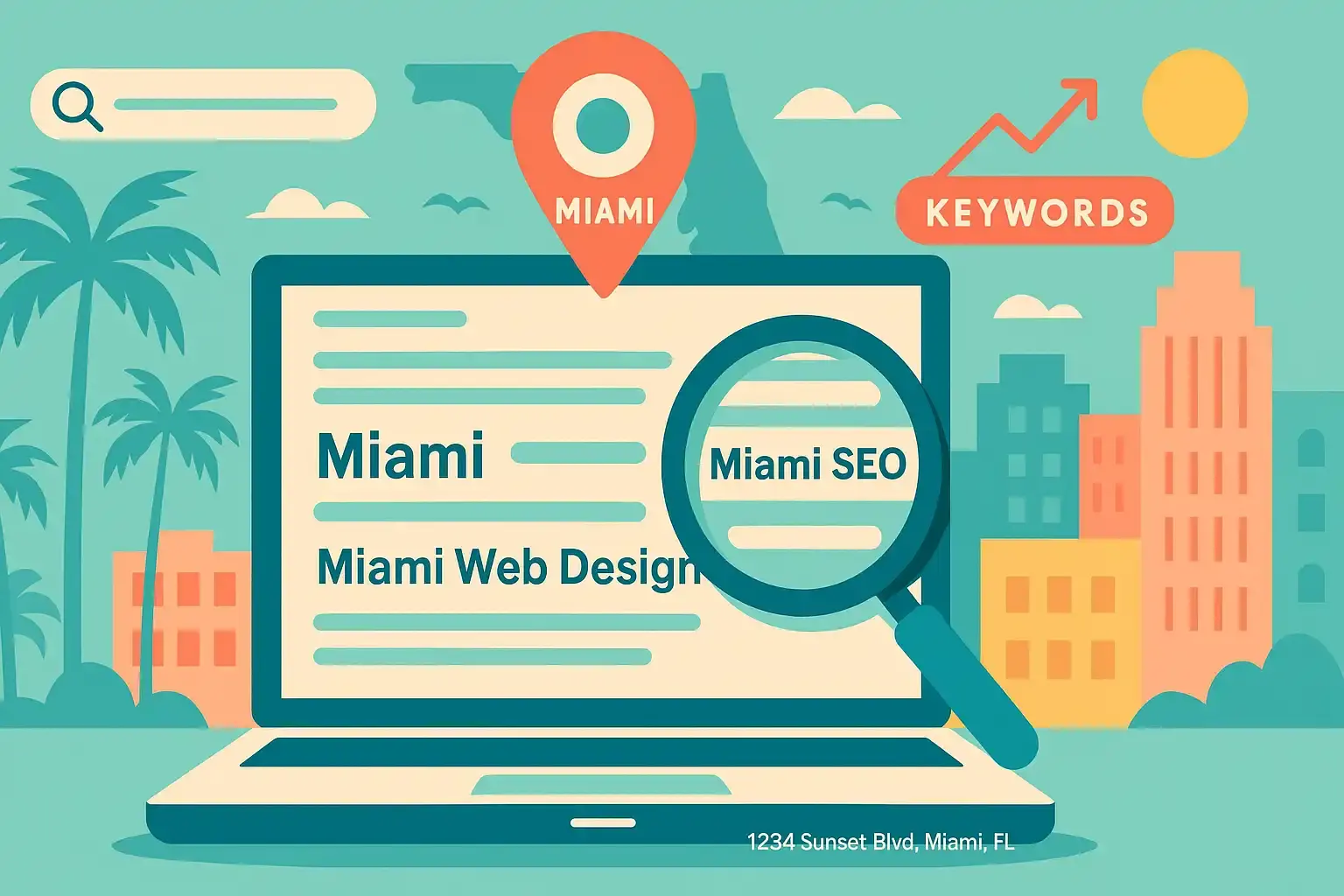
Your website remains a central component of your SEO strategy. To rank well for searches in Miami, you need to incorporate location-specific keywords into your site’s content in a natural, strategic way. This on-page optimization signals to search engines which area you’re targeting and what you offer. Here’s how to do it:
- Conduct Local Keyword Research: Start by identifying the terms people use when searching for your services in the Miami area. You’ve likely already identified some (like miami local seo, local seo miami, etc.), but think beyond those. Use tools (such as Google Keyword Planner, SEMrush, or Ahrefs) to find variations. For example, a web development agency might find people search for “best website development company Miami” or “Miami web designer”, whereas a plumbing company might see searches for “plumber in Miami 24/7” or “Miami plumbing repair Coral Gables”. Look for keywords that combine your service with local terms: “in Miami”, “Miami FL”, “near me” (Google often associates “near me” with the searcher’s location, so having city names on your site helps you be the result for those implicit location searches).
- Optimize Key Page Elements: Once you have a list of target phrases, incorporate them into critical parts of your website. The title tags (the meta title that appears in browser tabs and search snippets) of key pages should include relevant keywords and your location. For example, instead of a homepage title like “Welcome to Our Company”, use something like “Web Design and SEO Optimization Miami FL – YourCompanyName”. Similarly, use local keywords in your page headings (H1, H2) where it makes sense. The main heading of your homepage could be “Professional Web Development & SEO in Miami” with a subheading that includes Miami local SEO services, etc. Just as importantly, weave these location terms into your page content and meta descriptions. For instance, your About Us page might say, “We are a website development Miami agency serving clients across South Florida…” – which directly uses a keyphrase – and then continue with more details about your experience.
- Create Location-Specific Content: If your business serves multiple areas or neighborhoods, consider creating dedicated pages or sections for each. A contractor might have separate pages for “Roofing in Miami”, “Roofing in Miami Beach”, “Roofing in Fort Lauderdale” if they serve all those areas. For our case, you might create a page on your site specifically about “Miami Local SEO Services” or “Serving Miami Beach Businesses” – and on that page, discuss how you approach clients in those locales, include testimonials from clients in that area, etc. This can increase relevance for searches specific to that locale. However, avoid creating thin pages that only swap out the city name; each page should have unique, valuable content tailored to that area (for instance, mention Miami Beach’s market if targeting that page, such as tourist-driven SEO considerations).
- Natural Integration and Readability: While using local keywords is important, it’s equally crucial to keep your content readable and user-friendly. Keyword stuffing (cramming “Miami” or other terms into every sentence) will hurt more than help – search engines are smart enough to detect this, and it makes for a poor reader experience. Aim for a balance: for example, a paragraph on your homepage might naturally mention your city a couple of times (“As a proud Miami-based firm, we understand the local market… Our Miami local SEO experts have helped companies from Brickell to Miami Beach rank higher on Google…”). The text flows, includes different variations of location (Miami, Miami-based, Miami Beach) and the main services, but doesn’t feel repetitive or forced. You’ve already been given a list of keywords – use each at least once where they fit best (we’ll cover many of them throughout this article). Making them bold (as we do in this article) is one way to highlight them in text; it can draw the reader’s eye and possibly emphasize importance to search engines as well.
- Include Contact Details in Text: Ensure your site’s footer or contact page has your full NAP (Name, Address, Phone) details in text form. For example: “YourCompanyName | 1234 Sunset Blvd, Miami, FL 33101 | 305-123-4567”. Search engines often scan for this info on your site to confirm your location. Some businesses also embed a Google Map on their contact page showing their Miami location, which is great for user experience (customers can quickly get directions) and reinforces location signals.
By thoughtfully incorporating local keywords into your site, you send a clear message to Google about where your business is and which searches you should rank for. Over time, as you add more content (blogs, new pages), continue to use local terms when relevant – this sustained relevance strengthens your site’s association with the Miami area.
3. Create Locally Relevant Content
Content is king in SEO, and that holds true for local SEO as well. Developing content that resonates with a Miami audience can boost your visibility and establish you as an authority in the local community. Here are some content strategies:
- Local News and Events: Write blog posts or articles that tie your business into local Miami happenings. For instance, if there’s a major event like Art Basel or the Miami Tech Week, you could write about “How local businesses can capitalize on Art Basel foot traffic” or “SEO tips for Miami tech startups during Miami Tech Week”. A web developer might blog about the growth of the tech scene in Miami and how local SEO helps new startups get noticed. By covering local events or news topics and relating them to your industry, you naturally include location context and attract local readers who search for those events plus your industry.
- Local Guides and Resources: Creating helpful local guides is a great way to incorporate local keywords and provide value. For example, a marketing agency might publish a guide like “The Small Business Owner’s Guide to Online Marketing in Miami – 10 Essential Tips”. Or if you’re a caterer, you could write “Top 5 Miami Wedding Venues and How to Choose Catering for Each”. Think about what knowledge you have that intersects with local interests. These guides can attract backlinks from other local sites (e.g., a local tourism blog might link to your “Miami Beach restaurant marketing tips” article if it’s useful).
- Case Studies or Success Stories: If you have local clients that benefited from your services, create case studies highlighting their success (with permission, of course). For instance, write about how you helped “Client X increase their traffic by 50% through local SEO Miami strategies” – then detail what was done. Not only does this showcase your expertise (attracting potential leads), but you also naturally mention Miami in context. These stories make your content more engaging and personalized to the region.
- FAQ and Q&A Content: Consider adding an FAQ section (we’ll have a dedicated one at the end of this article) or Q&A pages on your site focusing on Miami-specific queries. For example, an FAQ on your site could answer “How does the Miami market affect SEO strategy?” or “What are the best online directories for Miami businesses?”. This targets long-tail searches (which often come in question form) and provides immediate value to readers.
- Multilingual Content if Applicable: Miami has a large Spanish-speaking population. If your business serves a bilingual audience, consider having content (or whole sections of your site) in Spanish as well. Even a few key pages translated to Spanish (with proper hreflang tags for SEO) can capture searches made in Spanish (e.g., someone searching “marketing digital Miami” or “restaurante Miami centro”). However, ensure the translations are professional – poorly translated content can backfire. If done right, this can be a significant competitive advantage, as not all local competitors will invest in multilingual SEO.
When creating local content, always remember quality over quantity. A well-crafted blog post once a month that truly speaks to local readers is better than weekly thin posts that just repeat generic info with “Miami” slapped everywhere. Engagement metrics (like how long visitors stay, whether they share or comment) matter to SEO too, so compelling content will send positive signals. Plus, great content is more likely to earn backlinks from other websites, especially local bloggers or news sites, which further boosts your SEO (more on local link building in a moment).
4. Ensure NAP Consistency and Build Local Citations
In the context of local SEO, NAP stands for Name, Address, and Phone number. Keeping your NAP consistent across the internet is a foundational tactic. Additionally, citations – which are mentions of your business’s NAP on other websites – help establish credibility and relevance in local search. Here’s how to tackle this:
- Consistency is Key: Make sure the way your business name, address, and phone are listed on your website exactly matches how they appear on your Google Business Profile and other listings. Even small differences (like “St.” vs “Street” or using a local call tracking number that differs from your main line) can confuse search engines or lead to duplicate listings. Pick a standard format and stick with it. For example, if your address is 500 South Biscayne Boulevard, decide if you’ll spell out “Boulevard” everywhere or always abbreviate to “Blvd” – then do it the same on all platforms.
- Major Directories and Listings: List your business on high-authority directories. Start with the big ones: Yelp, Bing Places, Apple Maps, Facebook business pages, LinkedIn company directory, and Yellow Pages. Ensure each listing uses the same NAP and includes your website URL. Filling out profiles thoroughly (business description, hours, photos, etc.) on these platforms can also improve your visibility within those ecosystems – e.g., having a good Yelp page can drive traffic from Yelp itself, aside from Google.
- Local and Niche Directories: Next, target Miami-specific and industry-specific directories. Examples: the Miami Chamber of Commerce directory, local business associations, industry associations (like a directory of web developers or a directory of attorneys if that’s your field). There may also be popular local blogs or websites that maintain lists of “Top X businesses in Miami”. Aim to get your business listed or mentioned on such sites. For instance, if there is a “Miami small business directory” or a local forum like Reddit’s r/Miami or Miami business groups, having a presence or mention there can be useful. Local SEO Miami success often comes from dominating not just Google, but all the places people might look for local businesses.
- Citations Beyond Directories: A citation doesn’t necessarily need to be a formal directory listing. It could be any mention of your business’s name with address or phone on a web page. Press releases in local news (e.g., a story in the Miami Herald about your company’s new product launch that includes your Miami address) count as citations. Sponsoring local events or charities can often get you a mention on their sites (“Thank you to our sponsor, YourCompanyName (address)”). All of these reinforce your association with the Miami area in the eyes of search engines.
- Use Citation Tools or Services if Needed: Managing citations can get tedious, especially if there are many. There are tools (like Moz Local, Yext, or SEMrush’s listing management) that can automate submission to multiple directories and monitor consistency. These can save time by pushing out your NAP info to dozens of sites and flagging any discrepancies. Alternatively, you can do a manual audit: search for your business name and see what comes up – if you find old addresses or wrong info on some listing, reach out to update it.
- Handle Duplicates and Old Info: If your business has moved or changed names/numbers in the past, make a concerted effort to clean up old data. Duplicate Google Business listings or old addresses on the web can confuse customers and search engines. Most directories have a process to remove or update listings – it’s worth the effort to ensure only current, correct information is out there. It may take some time (for example, contacting a site admin or going through verification again), but it contributes to a clean local search profile.
By building a strong network of citations, you effectively increase the online “footprint” of your business in Miami. Google’s local algorithm uses citations as a factor for determining prominence and trust. Think of it as corroboration: if dozens of reputable websites all have your business listed at the same Miami address and number, Google will be more confident that your business is legitimate and serving that area (which can boost your rankings). Plus, many of these directories themselves can drive referral traffic. A user might discover you on, say, a “Miami business directory” site and click through to your website – that’s an extra lead source beyond Google.
5. Generate and Manage Online Reviews
We touched on Google reviews earlier, but it’s worth diving deeper into the role of online reviews and ratings in local SEO. Reviews are not only influential for potential customers, but they also factor into search rankings. A business with numerous positive reviews will generally rank better (and definitely attract more clicks) than one with no or poor reviews. Here’s how to cultivate a strong review profile:
- Ask for Reviews Proactively: Satisfied customers are often happy to leave a review if you make it easy and ask at the right time. Develop a habit of requesting reviews. For example, after completing a project or sale, you might send a follow-up email: “Thank you for choosing our service. We hope you’re delighted with the results! It would mean a lot to us if you could share your experience in a quick review [link].” If you have a physical location, you could have a small card or sign at the checkout or reception area with a QR code linking to your Google review page, saying “Loved our service? Leave us a Google review!”.
- Focus on Google, but Don’t Ignore Others: Google Business Profile reviews are arguably the most important for local SEO rankings. However, potential customers also check other platforms. Yelp is widely used for restaurants, home services, and more; TripAdvisor if you’re in hospitality; industry-specific sites (like Avvo for attorneys, Healthgrades for medical professionals, etc.) if relevant. Aim to have a well-rounded presence. You don’t need hundreds of reviews on every site, but ensure you have a positive rating and some recent reviews on the major ones where people might look for your type of business. Many Miami residents check multiple sources – for instance, a restaurant might be Googled and also looked up on Yelp for more photos or detailed reviews.
- Respond to Reviews: Engaging with reviews shows that you value customer feedback and customer service. For positive reviews, a simple reply like “Thank you for your kind words, we’re thrilled you had a great experience!” can suffice. For negative reviews, respond promptly and professionally. Apologize if you were at fault and explain how you’ll address the issue. If the complaint is unfounded or from a difficult customer, keep your tone polite and offer to discuss/resolve offline. This not only possibly wins back the unhappy customer, but new prospects reading your response will see that you’re responsible and care. Occasionally, a well-handled response even prompts the reviewer to update their rating.
- Star Ratings in Search Results: You might notice some search results show star ratings underneath (this can happen if you implement certain schema or if Google pulls in a prominent rating from your profile). Having an average of, say, 4.8 stars visible right in the search snippet for your business is a huge advantage – it draws eyes and instills trust instantly. This is indirectly tied to having great reviews. By building up a high average rating, you increase the chances of Google showcasing it, which in turn can boost your click-through rate. And a higher CTR from search can further improve your rankings (Google sees that people prefer your result).
- Volume and Recency: Aim to gather reviews consistently over time. A steady flow (a few new reviews each month) is better than a quick burst and then nothing for a year. Recency matters because consumers find a review from last week more relevant than one from 3 years ago. It’s also believed that Google’s algorithm values recent active reviewing as a freshness signal. So this is an ongoing effort, not a one-time thing. Make it part of your standard operating procedure for customer interactions.
- Leverage Testimonials on Your Site: While reviews on third-party platforms are key for SEO, don’t forget to showcase some on your own website too. You can quote Google reviews or Yelp praises on your homepage or in case studies (perhaps with attribution like “– John D., Miami, FL” if the platform allows). This won’t directly boost SEO like external reviews do, but it’s good for converting visitors who land on your site. Seeing social proof from fellow Miami business owners or residents can tip the scales in your favor.
Incorporating a strong review strategy not only strengthens your local SEO Miami efforts (since both Google and customers see you positively), but it’s also just good business practice. People trust online reviews as much as personal recommendations in many cases. By nurturing this aspect, you build a virtuous cycle: good service -> good reviews -> higher ranking -> more customers -> repeat.
6. Mobile-Friendly Website and Fast Load Times
With so many local searches happening on mobile devices, having a mobile-friendly website is absolutely essential for local SEO. Google has even shifted to a mobile-first index, meaning it primarily uses the mobile version of your site for ranking and indexing. Beyond search engine requirements, think of user experience: if someone finds your site via a local search on their phone, you want to ensure they can quickly get the info they need (your services, contact, directions, etc.) without frustration. Here’s what to focus on:
- Responsive Design: Ensure your website uses a responsive design that automatically adapts to different screen sizes and orientations. On a phone or tablet, the layout should be easy to read and navigate – no pinching or zooming needed. Most modern website themes and builders are mobile-responsive by default, but always double-check on multiple devices. The menu should be accessible (often as a clear hamburger icon), text should be a readable size, and buttons or links should be easy to tap with a finger.
- Fast Load Speed: Mobile users are often on the move and expect instant results. A site that takes more than a few seconds to load can cause visitors to bounce (leave immediately). And page speed is a known ranking factor. Optimize your site for speed by compressing images (large images are a common culprit for slow pages – make sure you’re using appropriate dimensions and compression), leveraging browser caching, and minimizing unnecessary scripts or plugins. Consider using a content delivery network (CDN) if your site has heavy media – it can deliver content faster to users in specific regions (though if your audience is mostly Miami locals, a CDN is less critical than it would be for global reach). You can test your site’s speed with tools like Google’s PageSpeed Insights, GTmetrix, or Pingdom, which also provide suggestions for improvement.
- Mobile SEO Elements: Certain on-page SEO elements have particular importance for mobile. For example, having a clickable phone number on your site (using a tel: link) is user-friendly – mobile visitors can tap it to call you immediately. Make sure your address is also clickable to open in map apps. Additionally, pop-ups or interstitials can be very disruptive on mobile; Google actually penalizes sites that use intrusive pop-ups that cover content on mobile. If you have any mobile pop-ups (like for newsletter signups or ads), ensure they are easy to close and don’t ruin the user experience.
- Design for Local Action: Think about what a local customer on a smartphone might want to do on your site quickly. Possibly find your contact info, check your hours, or see your services/prices. Design your mobile homepage and landing pages to cater to these needs. For example, have a clear “Call Now” button or “Get Directions” button prominently if calls or visits are key to your business. If you’re a restaurant, ensure your menu is easily viewable on mobile. If you’re a service provider, maybe have a “Request a Quote” form that’s short and mobile-friendly (each additional field makes it harder on a small screen). By making it easy for mobile users to convert, you not only please customers but also send positive signals to Google (lower bounce rates, higher engagement).
- Technical SEO Checks: Beyond user-facing aspects, a few technical items: make sure your site doesn’t block important resources (CSS, JS) via robots.txt – Google needs to see your site as mobile users do. Also, implement schema markup where appropriate (more on schema in the next strategy). For example, using LocalBusiness schema with your address and phone can sometimes lead to Google displaying a rich snippet on mobile searches. Ensure you have an XML sitemap submitted to Google Search Console so your pages are indexed correctly, and fix any mobile usability issues that Search Console flags (like clickable elements too close, content wider than screen, etc.).
Given Miami’s hustle and bustle, many potential customers are searching while on the move – maybe looking for a place right now or quickly checking your services on their phone between meetings. A smooth mobile experience can be the deciding factor in capturing those leads. Google recognizes this, hence rewarding mobile-friendly sites. In short, fast and mobile-friendly = better local SEO and a better impression on your customers.
7. Local Link Building and Community Involvement
Link building for local SEO is about earning links from other websites that are relevant to your location or industry. Quality backlinks remain one of the strongest ranking factors in SEO. For local purposes, links from other Miami-based or Florida-based sites can especially boost your credibility in Google’s eyes (it’s like getting upvotes from your “neighbors”). Meanwhile, being involved in the community not only can lead to such links but also raises your profile among potential customers offline. Let’s look at tactics here:
- Local Partnerships: Build relationships with complementary businesses in the Miami area. For example, if you run a web development and SEO agency, you might partner with a local graphic design firm, IT service provider, or marketing consultants. You can refer clients to each other and, importantly for SEO, consider cross-promoting on each other’s websites. This might be a simple “Partners” page where you list and link to each other’s sites (with a bit of description). Or you could guest post on each other’s blogs (“An IT consultant writes a post on your site about cybersecurity for small businesses, and you write on theirs about SEO basics”) – these guest posts can include links back to your site as the author bio or within content. Google values contextual links from relevant content.
- Sponsorships and Local Events: Miami is full of events – from cultural festivals to charity runs to business conferences. Many events or nonprofits look for sponsors. Sponsoring an event (even a modest amount) often gets your business name and link on the event’s website (“Thank you to our sponsors: [Your Logo]”). These sponsorship pages usually have decent local visibility and a backlink. Plus, you get marketing exposure at the event itself. Choose events that align with your brand or where your target audience is likely to participate. For example, a children’s clothing boutique might sponsor a local kids’ fair, or a tech company might sponsor a Miami startup meetup.
- Local Press and PR: Getting mentioned in local news outlets or blogs can earn authoritative links. If you have newsworthy updates (new office, a free workshop you’re hosting, launching a new product/service, participating in a charity drive), send a press release to Miami Herald, South Florida Business Journal, or local news sites. Even community newspapers or niche magazines (like a Miami tech magazine or a neighborhood newsletter) can be valuable. Sometimes reporters look for local expert opinions – for instance, a journalist writing “How Miami businesses are adapting to digital marketing trends” might quote you, resulting in a mention and link. Networking in local business circles and using sites like HARO (Help A Reporter Out) can open such opportunities.
- Online Communities and Social Groups: While most links from social media or forums are “nofollow” (meaning they don’t directly pass SEO authority), being active in local online communities can indirectly help your SEO. For one, you can drive traffic to your site by sharing content in these groups, which may lead to more people knowing about you and potentially linking to you from their own sites. Join Miami business groups on Facebook, engage in Nextdoor if relevant, or contribute to discussions on sites like Quora or Reddit when people ask about your industry in Miami. Always be helpful, not just promotional. Over time, you’ll build a reputation as a local expert. Occasionally this can result in someone mentioning your business on their blog or a news piece simply because they remember you as the expert from that forum.
- Citations as Links: Earlier we talked about citations primarily for NAP consistency. Many of those listings also provide a link to your website (even if it’s a profile link). While directory links are not as powerful as content-based editorial links, they still count to diversify your link profile. Ensure all your directory listings include your web URL. Also, industry directories (for example, a directory of certified developers or a list of licensed contractors in Florida) provide both citation and link benefits.
- Quality Over Quantity: With link building, always prioritize quality. A few links from high-authority, locally relevant sites (like a link from miamiherald.com or from universityofmiami.edu if you did something newsworthy or collaborated with a school) can outweigh dozens of low-quality links. Avoid any spammy link schemes – do not buy links or use link farms, as Google can penalize that. The goal is to earn links by doing things that naturally attract attention and references.
Link building is often one of the harder parts of SEO because it involves external sites that you don’t control. However, in the local arena, you have the advantage of a community with many interconnections. By actively participating and contributing to the Miami business community, both online and offline, you’ll find that links and mentions start to accrue over time. These links act like endorsements, telling search engines: “This business is trusted and relevant in Miami.” Combined with all the other strategies, they give you that extra push toward the top of the rankings.
8. Leverage Technical SEO and Schema Markup
Technical SEO might sound intimidating, but it simply refers to site optimizations that make it easier for search engines to crawl, interpret, and index your website. For local SEO, one technical aspect worth highlighting is schema markup, specifically LocalBusiness schema, which can provide search engines with structured data about your company. Additionally, general technical best practices ensure your site’s foundation is solid. Here’s what to consider:
- Implement LocalBusiness Schema: Schema markup is code (often in JSON-LD format) that you add to your website’s HTML to define elements like business name, address, phone, reviews, etc., in a structured way that Google understands. By using the LocalBusiness schema (or a more specific subtype if appropriate, like Restaurant, ProfessionalService, etc.), you can explicitly provide your business details to search engines. This can enhance your search listings with rich information. For instance, have you ever seen a search result for a business that shows its star rating or operating hours right on Google? That’s often powered by schema data combined with Google’s own info. While not guaranteed, adding this markup can only help. At minimum, include your business’s name, address, phone, business type, and perhaps hours.
Below is an example of how a JSON-LD LocalBusiness schema snippet might look on your site’s code (you can put this in the <head> or the footer of your HTML):
This code provides search engines a clear map of your essential business info. You can adjust it to your details (and even extend it with more, like "url": "https://www.yourwebsite.com", or add "priceRange": "$$$" if applicable, etc.). After adding schema, use Google’s Rich Results Test tool to check if it’s implemented correctly.
- Ensure Site is Crawlable: Make sure your site isn’t accidentally preventing search engine bots from accessing important pages. Check your
robots.txtfile to see that you’re not disallowing any crucial sections. Also, ensure that you don’t havenoindextags on pages that should be indexed (I’ve seen cases where a developer left a noindex on the whole site from staging – a disaster for SEO!). In Google Search Console, inspect your pages to ensure they’re being indexed properly and no errors are reported. - Fix Broken Links and Errors: A technically sound site has minimal errors. Periodically scan your site for broken links (both internal and external) – tools like Screaming Frog or online crawlers can help. Fix any 404 errors by either removing the link or redirecting it to a correct page. Ensure your navigation is logical and all important pages are linked somewhere on your site (so neither users nor search bots have trouble finding them). For local businesses, it’s especially important that your contact page, about page, and service pages are easily accessible.
- Secure Your Website: Use HTTPS encryption (SSL certificate) site-wide. Not only is this a lightweight ranking factor (Google prefers secure sites), but it’s crucial for user trust. If a visitor sees “Not Secure” in the browser for your site, they may bounce. Obtaining an SSL certificate is straightforward (many hosts provide them for free or at low cost), and the boost to credibility is worth it.
- Page Structure and Tags: Use heading tags (H1, H2, H3) appropriately to structure your content – as we are doing in this article. A clear hierarchy of headings with keywords in them (when relevant) helps search engines understand the content of each page. Also, use descriptive, human-friendly URLs (for example,
yourwebsite.com/miami-seo-tipsinstead ofyourwebsite.com/p=123). For images on your site, use alt text describing the image and including a keyword if relevant (e.g.,<img src="team-miami.jpg" alt="Our Miami web development team">). Alt text helps with accessibility and can marginally help SEO by reinforcing context. - XML Sitemap: Maintain an XML sitemap listing all your important pages, and submit it in Google Search Console and Bing Webmaster Tools. This helps search engines discover and index your pages more efficiently, especially if your site is new or has been updated significantly. Most CMS platforms can generate a sitemap for you (or you can use a plugin).
By paying attention to technical SEO, you ensure there are no hidden obstacles holding back your seo optimization miami efforts. Think of it like tuning an engine for performance – your content and strategy are the fuel, but technical SEO is making sure the engine can use that fuel efficiently without any leaks or clogs. A well-structured, error-free website provides a strong foundation so that all the other local SEO work (great content, keywords, links, reviews) can shine and produce maximum results.
9. Track, Analyze, and Adapt Your Local SEO Efforts
SEO is not a one-and-done task, especially local SEO. It’s important to monitor your progress and adapt your strategies based on data and changing conditions. By tracking key metrics, you’ll know what’s working, what isn’t, and where to focus next. Here’s how to stay on top of your miami local seo performance.
- Google Analytics: Make sure Google Analytics (GA) is installed on your site. It’s a powerful (and free) tool to understand your traffic. Pay attention to metrics like overall traffic growth, and specifically organic search traffic (how many visitors are coming via search engines). GA allows you to see geographic data as well – you can check if your traffic from the Miami area is increasing over time, which is a direct indicator of better local visibility. Also, track user behavior: Are local visitors spending time on the site? Do they bounce quickly? If certain pages have high bounce rates, you might need to improve their content relevance or loading speed.
- Google Search Console: This is another free invaluable tool. Search Console shows you how your site is performing in Google search results. You can see the queries people use to find you – check for variations of your target keywords (are you seeing impressions for “Miami web design” or “local SEO Miami” etc., and at what average position?). It also alerts you to any technical issues like indexing errors or mobile usability problems, which you should fix promptly. Use the Performance report filtered by location = United States > Florida > Miami (or by specific queries containing “Miami”) to gauge how your local search presence is. If you find that you’re appearing often for a certain keyword but not getting many clicks, that may indicate an opportunity to improve your title/meta description to be more enticing.
- Local Rank Tracking: Consider using an SEO tool or service to track your rankings in local search. Some tools allow “local rank tracking,” where you can specify the city or ZIP code. This is important because local rankings can differ from general ones. For example, you might rank #3 for “web developer” for searchers physically in Miami, but that might not show up if you check generically or from another city. Tools like BrightLocal, Whitespark, or even the SEMrush local rank feature can be handy. They can monitor your position in the local pack as well as organic results for your chosen keywords in Miami. Monitoring these over time lets you see if your optimizations are moving the needle.
- Review and Reputation Monitoring: Keep an eye on your reviews across platforms using either manual checks or reputation management tools. Google sends notifications when you get new reviews on your Business Profile – respond to those. For Yelp and others, you might need to log in regularly or use a tool that aggregates new reviews in one dashboard. By staying on top of this, you can address any negative feedback quickly and show that attentiveness to anyone looking. Additionally, note if competitors are suddenly getting a flood of good reviews (maybe they started a campaign) – it might be time for you to ramp up your review acquisition efforts too.
- Conversion Tracking: Ultimately, higher rankings and more traffic are a means to an end: getting more clients or sales. Set up ways to measure conversions from your website. This could be contact form submissions, quote requests, phone calls, or e-commerce transactions, depending on your business model. Tools like Google Analytics can track form submissions or button clicks (with event tracking or Google Tag Manager), and there are call tracking solutions that can tell you if a call came via your website. If you see an increase in conversions from organic traffic as your local SEO improves, that’s the best validation that your efforts are paying off! Conversely, if traffic is up but not leads, you might need to work on your site’s content or call-to-action to better persuade visitors.
- Stay Updated on SEO Trends: The world of SEO, including local SEO, evolves. Google updates its algorithms frequently. What works today might need tweaking next year. Stay informed by following reputable SEO blogs or news (Moz, Search Engine Land, BrightLocal’s blog for local tips, etc.). For example, Google’s rolling out of new features like local service ads, changes to how the map pack is displayed, or new schema types could present new opportunities. Also, keep an eye on competitors – if a local competitor suddenly outranks you, analyze their site: Did they publish new content? Get new backlinks? Improve their site design? Use that intel to inform your next move.
By tracking and analyzing, you’re effectively closing the loop on your local SEO campaign: Plan -> Implement -> Measure -> Adjust -> Repeat. This approach ensures continuous improvement. Perhaps you discover that your website development Miami page is ranking well but your Miami Beach outreach is weak – you can then double down on content and citations for Miami Beach. Or you might find most of your leads are coming from one particular blog post you wrote – which suggests making more of that type of content. Data-driven decisions will amplify the success of your local SEO efforts over time, helping you dominate the Miami search landscape and achieve that coveted Top 5 Google position for your main keywords.
Services That Drive Local SEO Success in Miami
(In this section, we outline key services and solutions that contribute to a robust local SEO strategy. These are exactly the areas a business should focus on – either doing it in-house or by hiring professionals. Each item is a critical piece of the puzzle for dominating local search in Miami.)
- Miami local SEO – Comprehensive local search optimization, including Google profile management, on-page local keyword targeting, and localized content marketing to improve rankings in Miami’s search results.
- SEO optimization Miami FL – Full on-site and technical SEO improvements for Miami-based websites, ensuring fast performance, mobile compatibility, and proper meta tags so that search engines rank the site higher for relevant queries in Miami, FL.
- Website development Miami – Professional website design and development services tailored for Miami businesses, focusing on creating modern, responsive, and user-friendly sites that are optimized for both local users and search engines.
- Website development company Miami – A trusted web development partner in the Miami area that provides end-to-end solutions: building new websites or revamping existing ones with SEO best practices (clean code, schema markup, fast loading times) baked in from the start.
- Local SEO Miami Beach – Targeted local SEO strategies for businesses in Miami Beach and surrounding neighborhoods. This includes optimizing for location-specific keywords (like “Miami Beach restaurants”), managing online listings in Miami Beach directories, and capturing tourist traffic searching for services in that area.
- Local SEO Miami – Ongoing local SEO campaigns focusing on the Miami metro region. This covers continuous content creation (like blogging about Miami events), citation building, acquiring local backlinks, and analyzing local search performance to keep improving visibility for searches like “Miami + [your service]”.
- SEO optimization Miami – Broad search engine optimization efforts for the Miami market, combining local tactics with general SEO. This might involve keyword research specific to Miami slang or terms, competitor analysis within the city, and strategies to rank not just on maps but also high in the regular organic results for Miami users.
Each of these services plays a role in strengthening your online presence. In practice, a successful campaign ties all these pieces together: for instance, an expert team might start by developing a fast, mobile-ready website (website development miami) and then execute an ongoing plan of miami local seo – doing seo optimization miami fl on the site’s pages, setting up a Google Business Profile, creating content geared towards local seo miami, and building links and citations including in areas like local seo miami beach. By covering all these bases, a business maximizes its chances of outranking competitors and capturing the local audience.
(The above list underlines what an integrated approach looks like. Business owners in Miami often don’t have time to do all this themselves – which is why partnering with a website development company miami locals trust, or an SEO agency with local expertise, can be so beneficial. They handle the technical and strategic work, allowing you to focus on running your business while your online visibility grows.)
What is Miami local SEO and why does my business need it?
How long does it take to see results from local SEO in Miami?
What factors affect local SEO rankings for Miami businesses?
Relevance: How closely your business listing or website matches what someone is searching for. This is why optimizing for the right keywords (like “Italian restaurant Miami downtown” or “Miami plumber emergency”) is important. You want to signal to Google exactly what services you offer.
Proximity: How close the searcher is to your business location. If someone in Brickell searches for a coffee shop, a café in Brickell might rank higher for them than one in Coral Gables. While you can’t change your physical location, you can target multiple areas (through service area settings and content for nearby neighborhoods) if you serve them.
Prominence: This refers to how well-known and reputable your business is. Google gauges this through reviews (quantity and quality), overall star rating, and even mentions of your business around the web (citations and links). A business with 100 five-star reviews will have more prominence than one with 5 reviews. Offline prominence can matter too (for example, if your business is a famous museum or landmark, that’s considered).
Website Quality & SEO: The optimization of your website (on-page SEO, mobile friendliness, fast loading, etc.) affects your local ranking. A well-optimized site with local content will bolster your chances of appearing in both the local pack and regular organic results. Technical factors (secure site, proper schema markup, no broken links) also play a supporting role.
Google Business Profile Optimization: A complete, accurate, and active Google listing is crucial. Businesses that keep their profiles updated with correct info, respond to Q&A, post updates, and have lots of photos tend to perform better. Think of your Google profile as a mini-homepage for Google – it needs to be as robust as possible.
Local Backlinks: Links from other Miami or Florida websites act as “votes of confidence”. If a respected local blog or the Miami Herald links to your site, that can boost your credibility and rankings. The more local online relationships you build, the better.
In summary, to improve your local rankings, focus on providing accurate info to Google, optimizing your site for local keywords, earning reviews and links, and making sure everything about your online presence is geared toward demonstrating you are a leading and trusted business in Miami.
Can I do local SEO myself, or should I hire a professional in Miami?
Time and Consistency: Effective local SEO isn’t a one-time setup; it requires ongoing effort (writing new content, continuously managing reviews, updating listings, analyzing traffic). As a business owner, you might find it challenging to keep up with these tasks regularly. A professional will handle that workload for you.
Expertise: SEO specialists (particularly those experienced in the Miami market) know the nuances and advanced tactics that you might miss. For example, they can conduct in-depth keyword research, competitor analysis, implement structured data, fix technical issues on your site, and build higher-quality backlinks. They stay updated on SEO trends and Google updates, so they can quickly adapt your strategy as needed.
Tools and Resources: Agencies often have access to premium SEO tools (for tracking rankings, conducting audits, etc.) that might be too expensive for a single business to justify. They can provide detailed reports and insights using these tools. They might also have established connections – for instance, a local SEO agency may have media contacts or partnerships for earning backlinks that you wouldn’t easily get on your own.
Holistic Strategy: Professionals can integrate local SEO with other marketing efforts. For example, they might coordinate your local SEO with PPC advertising (“Google Ads”) or social media campaigns for maximum impact. If your goal is to dominate the Miami market, a multi-channel approach might serve you best, and an agency can align those campaigns together.
If you decide to go with a pro, make sure to choose someone reputable. Ask for references or case studies of other Miami businesses they’ve helped. Whether you DIY or hire, remember that understanding the basics is beneficial. Even if you hire an expert, knowing what they’re doing (at least at a high level) will help you have meaningful conversations and set the right goals.
Do I need a website for local SEO in Miami, or is a Google listing enough?
Credibility and Detail: Customers often want to click through to a website to learn more about a business. Your site can provide detailed information that won’t fit in a short Google listing – like your portfolio, in-depth descriptions of services, pricing, staff bios, etc. Not having a website can make your business appear less established. Many users might skip over a listing with no website because they can’t verify details or get a feel for the business online.
Ranking in Organic Results: Beyond the local map pack, a website allows you to rank in the broader organic search results. For example, a well-optimized page on your site could rank for “tips from a Miami real estate agent” or “best Miami catering for weddings” and attract visitors via those queries. These are visits you’d never get with just a Google listing. Also, owning a website is owning a piece of internet real estate – you’re not fully dependent on Google’s platform.
Control and Customization: On your website, you have full control over content and SEO elements. You can target the exact additional keywords you want (like writing a blog post targeting seo optimization miami queries or showcasing that you’re a website development company Miami businesses trust). You can design it to guide the user experience towards contacting you or purchasing. A Google listing is uniform and limited in scope – valuable, but not sufficient for a robust digital marketing strategy.
Integration with Other Services: Having a website allows you to leverage analytics, retarget visitors with ads, collect email sign-ups, and so on. For instance, you might get a visitor from your Google listing, and on your website they fill a contact form or sign up for a newsletter – now you have a lead you can nurture. Without a site, that visitor might just see your phone number and move on without contacting you.
In summary, while you can get started with local SEO using just a Google listing and social media, for the best results a well-optimized website is important. If you don’t have one, it’s wise to invest in creating one. You might consider working with a website development company miami (a local web developer) to build a site that not only looks professional but is also SEO-friendly from the ground up. The combination of a powerful website and an optimized Google profile will give you a much stronger presence than either one alone.